Travel
Mirror
Originally published on Tumblr ·
It’s finally up. The sunburst mirror I bought in Peru. I remember how I carefully placed it in overhead compartments and galleys on my three-legged flight home. And before that, I remember how I circled San Blas to find a better deal or a better piece before returning to El Centro where I decided this beautiful mirror would be embarking on a crazy journey with me.
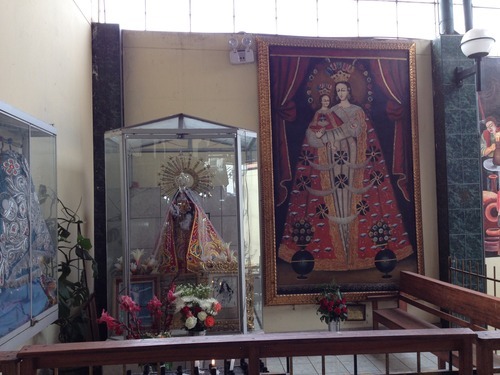
A religious corner inside El Centro market.
He sat, like most other storekeepers, on a stool in the interior of his shop with a blanket covering his legs, working on something. As I hovered on the edges of the store inspecting a mirror, I noticed he was talking to a regal older woman. Their animated chatter was in Quechua—the Inca language still spoken today. She turned her back on the storekeeper and slowly began to exit the store, inspecting the religious paintings, crosses, and other artifacts as she did, and their conversation trickled down to silence.Our eyes met and she began to admire the same mirror I was looking at. She had a perfect, hoary bob and wore a long black jacket, with a red scarf draped along its lapels and elegant silver jewelry. Her deep-set eyes were lined with black. “¿Bonito, no?” she said. I agreed, it was a circular mirror with a ring of red glass work and a ring of blue glass work along with gilded spokes in the shape of a stem with a flower—beautiful. “Pero muy caro,” I whispered–95 soles seemed like a lot for something from a local market. She nodded and said she would try to get me a discount, but after a brief exchange with him she walked away and waved goodbye.
The old man remained on his stool—intransigent and seemingly not keen to sell (in sharp contrast to the other, mostly female, shopkeepers who would kindly invite you to come into their stores while advertising their wares). I decided to enter the store and try my luck. I asked for his final price and if he had other mirrors of that size, at which point he brought out a mirror nestled behind him under a table. It was more impressive than the one that initially caught my eye and I couldn’t keep up my poker face. It had an inner ring of black glasswork, an outer ring of orange glasswork and radiating spokes in the shapes of stems capped by simple flowers and tulips. A brief negotiation later, I was able to bring him down to 85 soles, but I decided to look around. I had never really made a purchase like this before. How would I transport it? Do I need it? Am I being silly? He remained on his stool all the while.
My friend and I continued to wander around the market when the silver-haired woman reappeared; she asked if I had bought the mirror. When I said that I had hesitated, she said she was heading to San Blas, where many stores sell this type of craft and that we should check it out. We chatted briefly and she walked away with a friendly smile. A storekeeper within earshot mentioned that El Centro houses mostly producers and craftsmen, whereas San Blas would be re-sellers with higher prices, but we decided it was worth a shot.
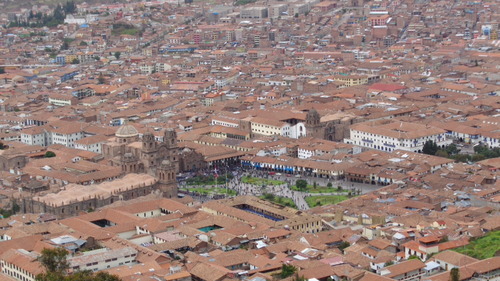
Plaza de Armas from atop the hill overlooking Cusco city.
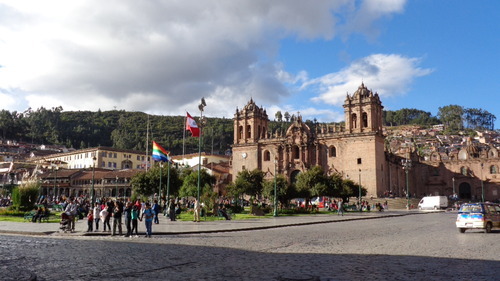
Plaza de Armas–a focal point of Cusco.
Plaza de Armas is where Francisco Pizarro formally conquered the city then known as Qosqo and Tupac Amaru II, the leader of the resistance, died.
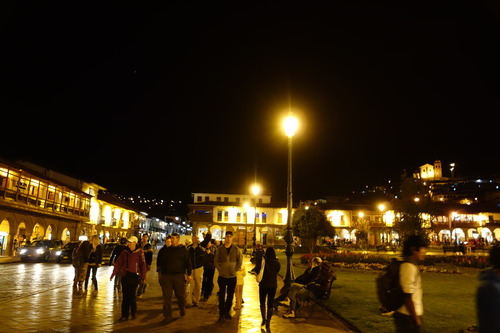
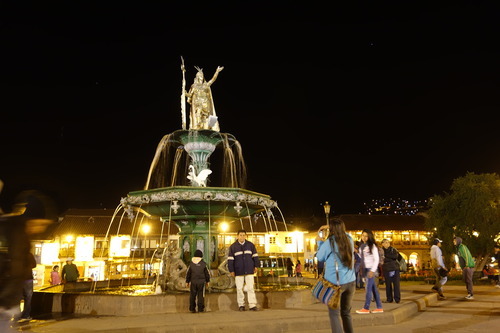
The scene at night–Plaza de Armas.
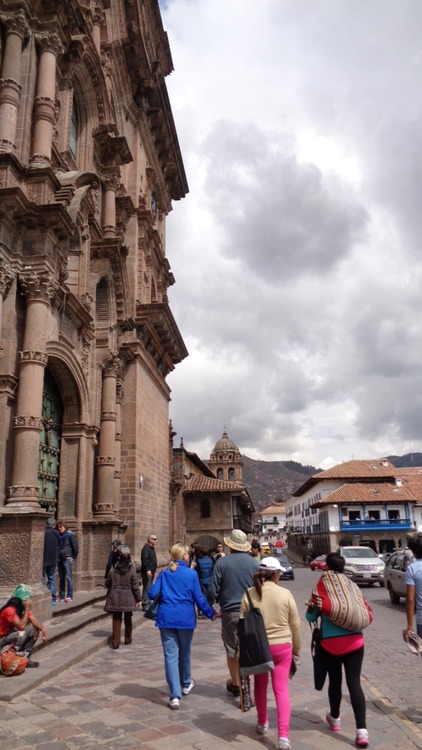
Walking around Plaza de Armas.
From La Plaza de las Armas we began the uphill climb on Calle Triunfo and passed Hatun Rumiyoc–a long Inca wall–along the way. The narrow cobblestone streets are flanked by white-walled enclosures with striking blue doors and balconies, behind which are art galleries and artisan shops.
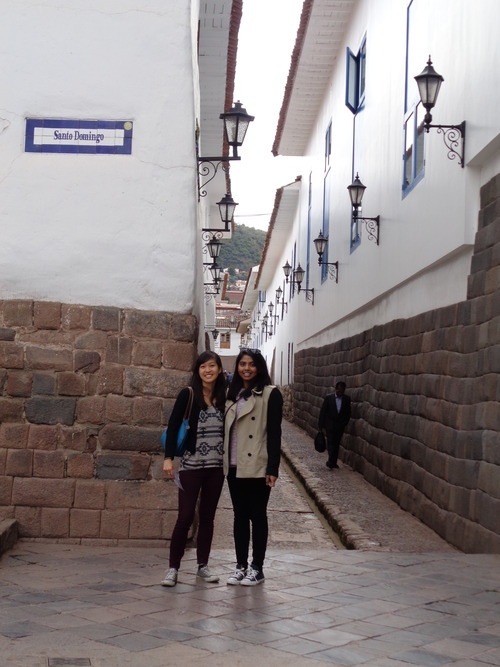
An Inca wall off of Calle Santo Domingo; the entrance to our hotel is down the street and on the left.
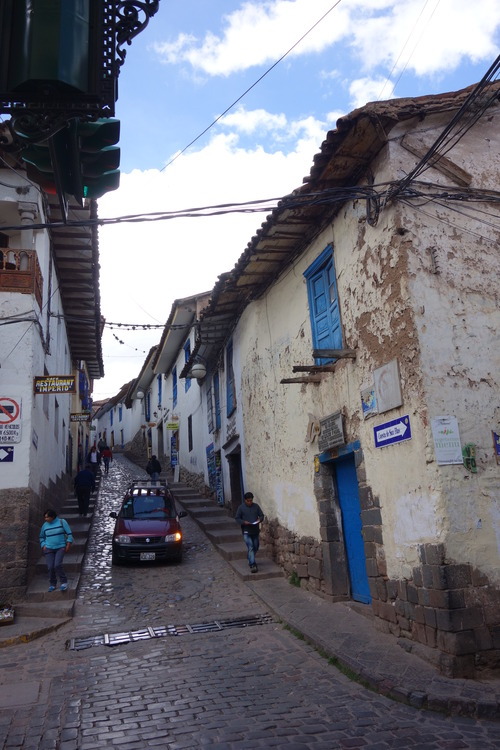
It’s no Lombard street, but it’s uphill! San Blas.
Each store had impressive, mostly Catholic, art. They also sold the mirrors I was looking for, but they were much more expensive and not particularly better quality. We quickly learned that everything here was overpriced, which was odd considering the bohemian vibe with dread-locked hippies scattered around the streets peddling their handmade junk. The storekeepers were also clearly more slick and chatty–they were not producers or craftsmen either.
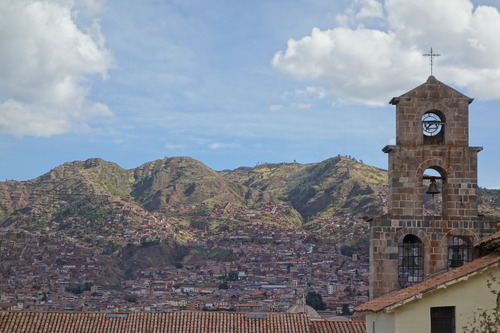
View from Plaza San Blas
We made our way up to Plaza San Blas for a spectacular view of Cusco city. The focal point of what is commonly known as the artist district is the church of San Blas. As is typical of many Peruvian churches, its somewhat plain exteriors belie an ornate pulpit. The pulpit at San Blas is arguably the most famous churrigueresque work– a single piece of cedar carved into elaborate religious imagery with elaborate gold filigree. This baroque influence arrived with the Spanish and was evident from the construction of the church in 1544. Light was believed to have a divine quality, so things that reflect it–gold and mirrors, feature prominently across altars and pulpits.
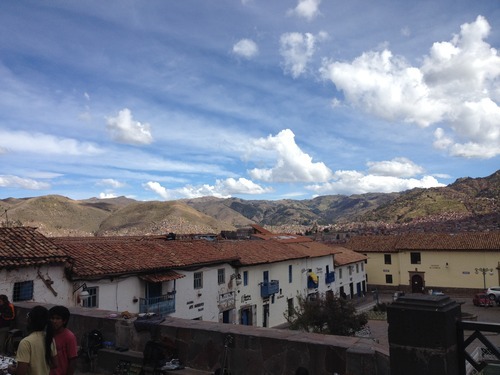
Another view from Plaza San Blas.
We walked back down empty handed, but certain that I had found a good deal. That is, if he was still there and willing to stick with his previous offer. Surely he wouldn’t increase the price now, knowing that I’m obsessed with that mirror? “I would,” said my friend. We picked up the pace and made our way back to El Centro, going downhill on Avenida El Sol and stopping for an empanada along the way.
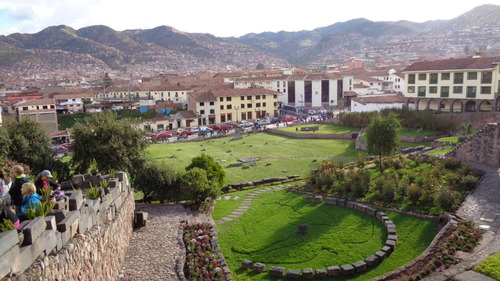
Avenida El Sol as seen from The Church of Santo Domingo/ Qorikancha (Sun Temple). The Church was built upon a gilded Inca temple.
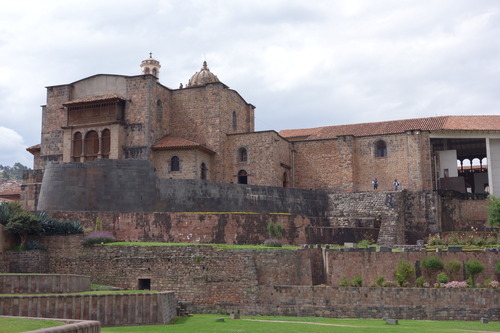
Church of Santo Domingo/Temple of the Sun beside Avenida El Sol.
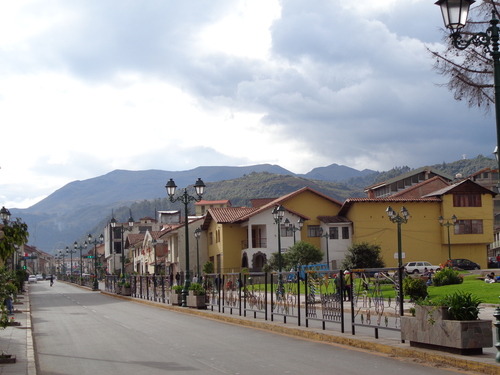
Further down La Avenida El Sol towards El Centro.
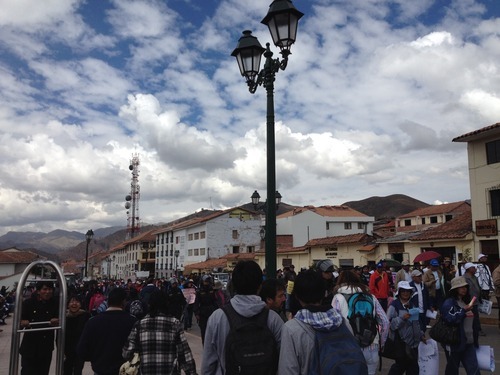
Walking down Avenida El Sol on a busy Saturday, with a parade of medical professionals rallying for better worker rights.
I was back at the old man’s store, but he was nowhere to be found. I waited and walked around asking neighboring storekeepers if he would be back. He returned a short while later and I told him I was ready to buy the mirror. I handed him the money as he reached behind his stool for newspaper wrapping. No bubble wrap? I began to realize what a challenge this would be and I wondered if this crazy dream would turn into a disaster. He fastened the last of a mere three layers of newspaper and got up and handed me the mirror–I felt like I had won a prize.
I remember all the times that I nearly dropped it, and the specter of seven years of bad luck. How a flight attendant kindly offered to stow it in the galley and risk a few years of unfortunate events for me. I almost had to check it in for my last leg in the U.S., where carry-ons are supposed to be tidier and more predictable.
It’s been a month since I anxiously unwrapped it at home. I’m convinced my Peruvian purchase is where it belongs and that our fates are now tied together.
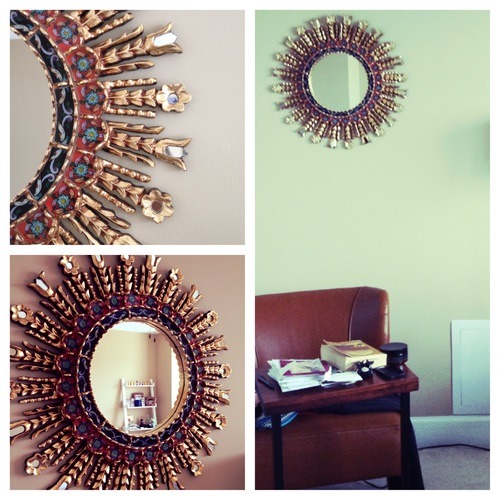
The mirror, at home.